Goblet Squat
The best squat to learn the squat
Body Part
Legs
Equipment
Dumbbell
Level
Beginner
Type
Compound
Force
Push
The goblet squat has you hold a single dumbbell or kettlebell at chest height while squatting, and that front-loaded weight acts as a counterbalance that almost forces good upright form. It's the most beginner-friendly squat there is — it teaches depth, bracing, and knee tracking with near-zero risk and no rack required. Even advanced lifters use it as a warm-up, a high-rep finisher, or a mobility drill.
Muscles Worked
In Position
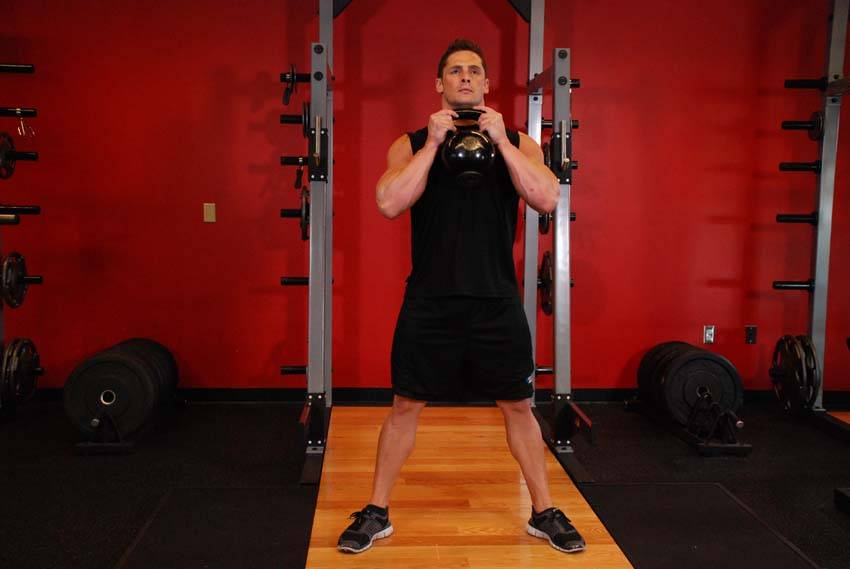
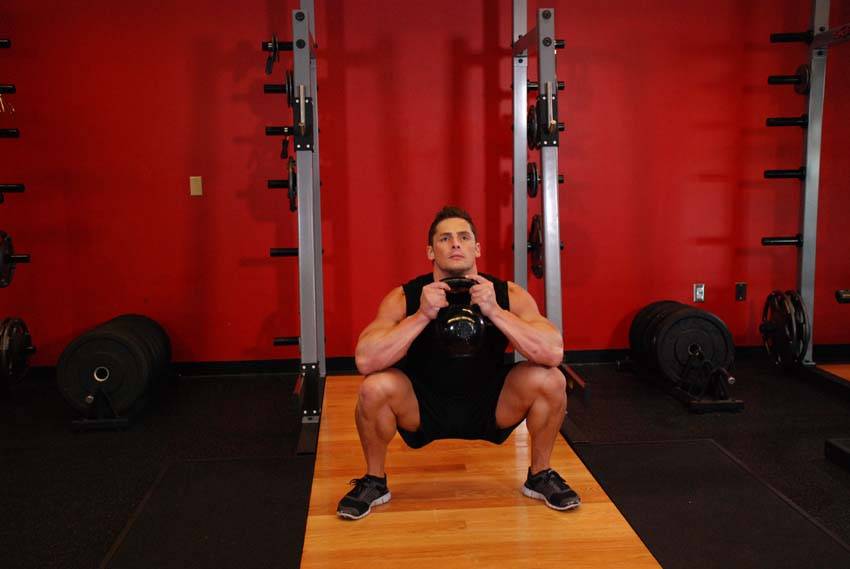
How to Do the Goblet Squat
- 1Hold a dumbbell vertically by one end, or a kettlebell by the horns, cupping it against your chest with both hands and elbows tucked in.
- 2Stand with your feet about shoulder-width apart and your toes turned out slightly.
- 3Take a breath into your belly and brace your core, keeping the weight pinned to your chest and chest tall.
- 4Sit straight down between your legs, pushing your knees out over your toes and keeping your torso upright.
- 5Descend until your elbows touch the inside of your knees or your hip crease drops below your knees, pausing briefly if you want a mobility benefit.
- 6Drive through your midfoot to stand back up, keeping the weight against your chest and your core braced, then reset for the next rep.
Coaching Cues
Common Mistakes
Variations & Related Lifts
What Lifters Say
Based on 12,000 online discussions
The goblet squat is the near-universal recommendation for teaching the squat, and the community treats it as the best on-ramp to barbell work. Holding a weight at the chest counterbalances your bodyweight so you naturally sit into an upright, deep squat, which means beginners groove a clean pattern almost immediately. It's loved precisely because it's hard to do badly and it builds confidence fast.
In practice, the goblet squat feels intuitive and friendly — you can chase depth, add pauses for mobility, and crank out high reps without worrying about safety bars or a spotter. Most people program it as a primary squat while learning, then later as a warm-up, accessory, or finisher. The main thing to expect is that your grip and upper back will eventually limit you before your legs, which is the signal it's time to graduate to barbell squats for more loadable strength work.
Goblet squats are best for beginners, anyone rebuilding their squat pattern, and lifters who want a joint-friendly quad and mobility movement. There's very little form debate here — the consensus is that it's the safest, simplest squat to coach. Compared to the back squat it offers far less maximal loading but far more accessibility and lower risk; compared to the front squat it's the easy, beginner version of the same upright, front-loaded pattern that you can scale up to over time.
Why Lifters Love It
- Easiest squat to learn — the front load naturally counterbalances you into an upright, well-positioned squat
- Teaches depth, bracing, and knee tracking that transfer straight to barbell squats later
- Nearly risk-free since you can simply drop or set down the dumbbell if a rep goes bad
- Requires no rack or barbell, so it's perfect for home gyms, hotels, or crowded commercial floors
Common Pitfalls
- Loading is capped by how big a dumbbell you can hold to your chest, so it can't be your main strength driver
- Grip, upper back, and arms often fatigue and fail before the legs on heavier sets
- Awkward to load heavy because cleaning a big dumbbell up to the chest becomes its own limiting step
- Easy to dismiss as too easy and never push the weight or reps hard enough to grow
Keep Reading
- Bret Contreras: A Set of Goblet Squats per Day Keeps the Doctor Away — Bret Contreras
- The History of the Goblet Squat (Dan John's invention) — Physical Culture Study
- StrongFirst forum: Goblet Squat — how to use it to move better — StrongFirst Forum
Frequently Asked Questions
Is the goblet squat good for beginners?
How heavy should I go on goblet squats?
Goblet squat vs barbell squat — which should I do?
Can goblet squats build muscle?
How do goblet squats help my squat mobility?
How do I hold the dumbbell for a goblet squat?
Related Exercises
Barbell
Barbell Back Squat
The king of lower-body lifts
Dumbbell
Bulgarian Split Squat
The most hated, most effective leg builder
Barbell
Front Squat
Upright squatting for monster quads
Dumbbell
Walking Lunge
Single-leg strength on the move
Bodyweight
All Fours Quad Stretch
Quads · Bodyweight
Bodyweight
Alternate Leg Diagonal Bound
Quads · Bodyweight
Library last reviewed June 22, 2026 · How these guides are written